
Losing a tooth affects far more than the appearance of your smile—it compromises your ability to chew comfortably, speech clarity, and long-term jawbone health. While traditional dentures and bridges rest on top of the gums, dental implants replace both the root and crown of a missing tooth. At Craft of Dentistry in Austin, TX, our team utilizes advanced implant technology to deliver permanent, natural-looking replacement teeth that restore total function and confidence to your smile.

A Permanent Solution For Missing Teeth
A dental implant consists of three essential components: a bio-compatible titanium post surgically placed into the jawbone, a custom connector piece (abutment), and a tooth-colored ceramic crown. Because the titanium post fuses directly with your natural jawbone, implants provide an immovable foundation that looks, feels, and functions like a natural tooth. Dental implants are ideal for:
- Replacing a single missing tooth: Restores a missing tooth without altering or grinding down healthy adjacent teeth.
- Supporting dental bridges: Anchors multiple replacement teeth securely without relying on neighboring natural enamel for support.
- Securing full or partial dentures: Eliminates slipping, uncomfortable clicking, and messy adhesives by snapping dentures onto strategic implant posts.
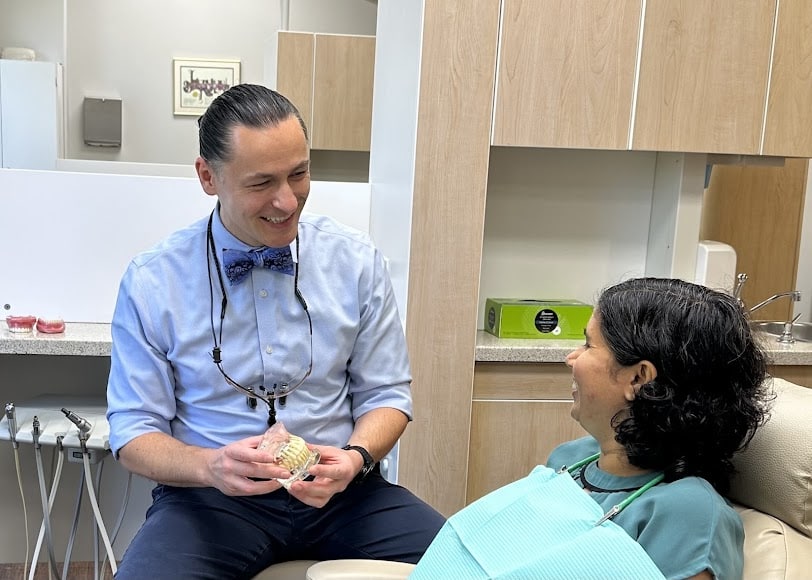
The Dental Implant Process
Achieving a restored smile with dental implants involves a precise, multi-phase treatment plan designed for optimal stability and aesthetics:
- Comprehensive evaluation and 3D imaging: We capture high-definition digital x-rays and 3D CBCT scans to evaluate bone density and map out precise implant positioning.
- Placement and osseointegration: The biocompatible titanium post is gently placed into the jawbone. Over the next 3 to 6 months, the bone naturally fuses to the post through a process called osseointegration.
- Restoration and final polish: Once fully integrated, a custom abutment and shade-matched porcelain crown are attached, completing your new, permanent smile.

Benefits Beyond Tooth Replacement
Choosing dental implants offers significant long-term oral and structural health advantages that traditional tooth replacements cannot match:
- Prevents jawbone loss: Biting forces transmitted through the titanium post stimulate the jawbone, preventing bone resorption and facial sagging that follow tooth loss.
- Protects neighboring natural teeth: Unlike bridges, implants require no reduction or shaving of surrounding natural enamel.
- Restores full chewing power: Enables you to eat your favorite foods, chew hard textures, and speak with complete clarity.
- Offers exceptional durability: Designed to last a lifetime when maintained with proper daily hygiene and routine dental care.
Long-Term Implant Care & Maintenance
Caring for a dental implant is just as simple as maintaining your natural teeth:
- Brush and floss daily: Clean around the implant crown and gumline every day using a non-abrasive fluoride toothpaste and dental floss.
- Wear a custom nightguard: If you clench or grind your teeth during sleep, a protective nightguard shields your ceramic restoration from excessive pressure.
- Schedule regular check-ups: Attend routine hygiene cleanings and check-ups so our team can evaluate surrounding gum tissue and implant stability over time.
Frequently Asked Questions
What Is A Dental Implant?
A dental implant is a small biocompatible post placed into the jawbone to support a replacement tooth or dental prosthesis. Once the implant integrates with the surrounding bone, it can support a crown, bridge, or implant-supported denture.
Who Is A Good Candidate For Dental Implants?
Many adults with missing teeth may be candidates for dental implants. Factors such as gum health, available bone, overall health, smoking or vaping, medications, and certain medical conditions can influence treatment planning and healing.
Are Dental Implants Painful?
Local anesthesia is used to numb the treatment area during implant placement. Patients may experience pressure or movement during the procedure, while temporary soreness, swelling, or tenderness can occur during the early stages of recovery.
How Long Does The Dental Implant Process Take?
The complete process often takes several months because the implant needs time to integrate with the jawbone before receiving its final restoration. The timeline varies based on healing, bone quality, grafting needs, the number of implants, and the type of restoration being placed.
What Is Osseointegration?
Osseointegration is the biological process through which living bone forms a stable connection with the implant surface. This integration provides the support needed for the implant to function as the foundation for a dental restoration.
Do I Need A Bone Graft Before Getting A Dental Implant?
Not everyone needs bone grafting. A graft may be recommended when there is insufficient bone volume or anatomy to support the planned implant. Digital imaging can help your dentist determine whether grafting is necessary.
Can A Dental Implant Be Placed Immediately After An Extraction?
In selected cases, an implant can be placed during the same appointment as a tooth extraction. Immediate placement depends on factors such as available bone, infection, implant stability, gum tissue, and the location of the tooth.
How Long Do Dental Implants Last?
Dental implants are designed to provide long-term tooth replacement and can remain functional for many years with appropriate care. Longevity varies based on oral hygiene, gum and bone health, bite forces, smoking, health conditions, and routine professional maintenance. The restoration attached to the implant may eventually require repair or replacement.
Can Dental Implants Help Prevent Bone Loss?
Dental implants transfer functional forces into the surrounding jawbone and can help maintain bone in the area of the implant. However, implants cannot prevent every age-related or disease-related change to the jawbone.
Can Dental Implants Replace Multiple Missing Teeth?
Yes. Dental implants can be used to replace a single tooth, support an implant-supported bridge for several missing teeth, or help stabilize a prosthesis when many or all teeth in an arch are missing.
What Is The Difference Between A Dental Implant & A Bridge?
A traditional dental bridge generally relies on neighboring teeth for support, while a dental implant is anchored within the jawbone. Because an implant can independently support a replacement tooth, healthy adjacent teeth may not need to be prepared for crowns.
How Do I Care For A Dental Implant?
Brush thoroughly around the implant restoration and gumline, clean between the teeth or beneath implant-supported restorations as instructed, and maintain regular professional exams and cleanings. Specialized floss, interdental brushes, or water flossers may also be recommended depending on your restoration.
Can Dental Implants Get Cavities?
The implant and its crown cannot develop cavities like a natural tooth. However, plaque can accumulate around an implant and contribute to inflammation or disease in the surrounding gum and bone tissues, making daily hygiene and professional maintenance important.
What Can Affect The Success Of A Dental Implant?
Bone quality, gum health, oral hygiene, smoking or vaping, uncontrolled medical conditions, teeth grinding, infection, and adherence to aftercare can influence implant healing and long-term stability. Your dentist will review relevant risk factors during treatment planning.
How Much Do Dental Implants Cost In Austin, TX?
Dental implant costs vary depending on the number of teeth being replaced, imaging, bone grafting or other preparatory procedures, the number of implants, and the final restoration. Craft of Dentistry can evaluate your needs and provide a personalized estimate for dental implants in Austin, TX.
Call our office in Austin, TX
today
To schedule your consultation and discover how dental implants can permanently transform your smile.